How to arrange a three-day city trip: zones, transport and rain backup
This is a desktop planning example for three days in Tokyo. It contains no record of an actual visit, no ticket purchase and no real accommodation booking. The aim is to show how to turn a list of places into a route that a group can check and adjust before departure. The example assumes a base near Tokyo Station and a full daytime window on each of the three days; if arrival or departure takes half a day, remove activities instead of squeezing them in.
Official sources were checked on 31 October 2026. Opening hours, closures and transport can change, so recheck the operator pages for your own dates before relying on this plan.
Set daily activity levels and your accommodation base
Choose one main activity for each day, then add one optional activity that can be cancelled. Write the accommodation area, the earliest realistic departure time and the latest return time in the same table, so everyone can see how much time is actually available. The base in this example is only a planning assumption; it is not a hotel recommendation and there is no claim about room rates or convenience.
Day one can use the Asakusa area, day two the Tokyo National Museum in Ueno, and day three the Imperial Palace East Gardens and the area around Tokyo Station. These are exchangeable days, not fixed weekdays. Find out which places close on which days before assigning dates. If you already have a timed booking, use it as the anchor and rebuild the day around it rather than forcing it into an already full schedule.
Keep the number of must-do items small. A plan that can lose one stop without collapsing is more useful than a list that only works if every train, queue and meal finishes exactly on time.
Divide the city with public maps
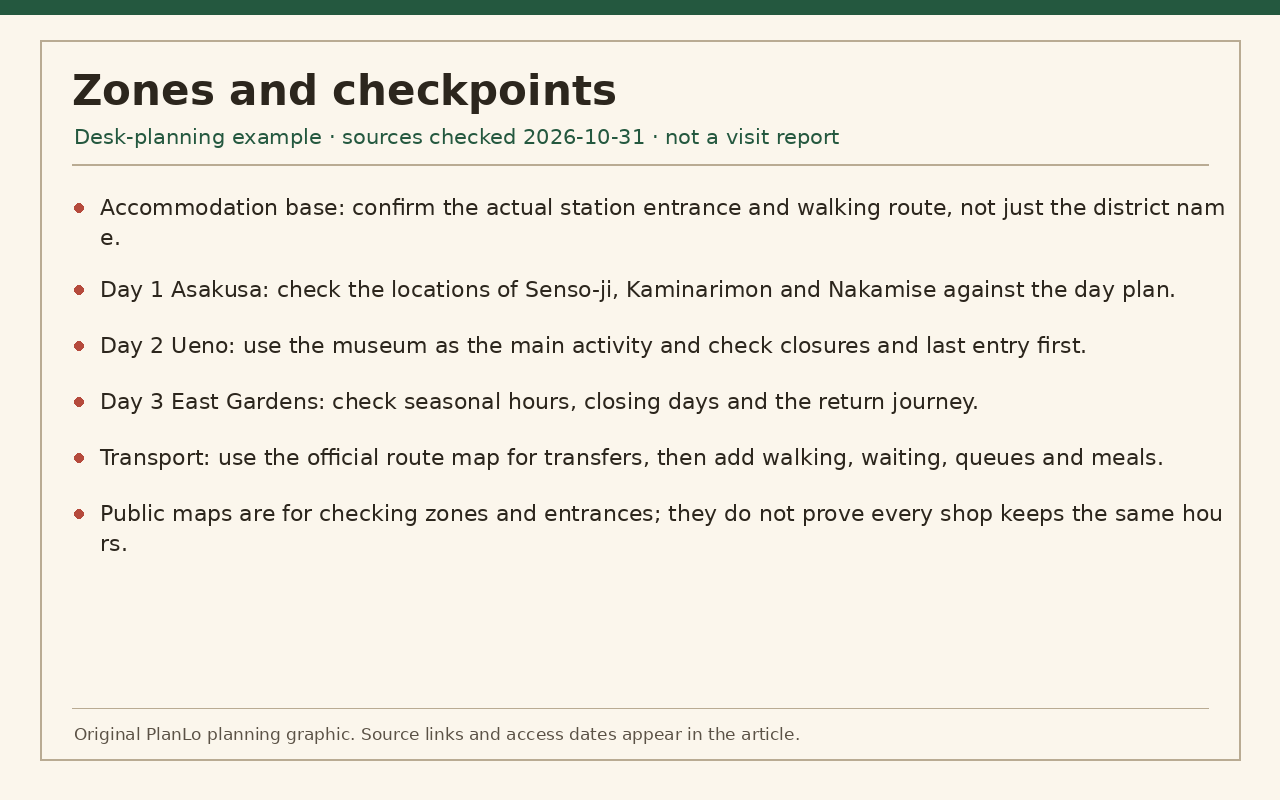
Search for the accommodation, each activity and its actual entrance on a public map, then compare the result with the operator’s transport map. The official GO TOKYO guide to Asakusa lists Senso-ji, Kaminarimon and Nakamise as the main elements of the area, which makes it a reasonable starting point for day one. That does not mean every shop keeps the same hours or that the whole area can be covered in a fixed number of hours.
The Tokyo Metro route map gives line and station-number information that can be checked against station details when planning transfers. Asakusa and Ueno are also served by Toei, Tobu and JR, so check those operators’ maps too. Do not simply draw a straight line between two place names. Confirm which station entrance you will use, which entrance leads to the destination, and whether companions can manage stairs, long walks or a rainy section. This example does not invent journey times or fares that were not tested.
Check opening hours and transport
For this example, the official Tokyo National Museum visitor information lists regular opening hours of 9:30 to 17:00, with extended days, special exhibition differences and last-entry limits. It is generally closed on Mondays (holidays excepted; when Monday is a holiday the museum opens Monday and closes the following weekday), with last admission 30 minutes before closing. The plan therefore gives the museum a full daytime window and does not assume that every evening visit is possible. Recheck closures and exhibition arrangements for your chosen date instead of keeping one screenshot of the regular hours.
The Imperial Palace East Gardens visitor information lists closing days including Mondays and Fridays, with exceptions, and seasonal opening times. In October the general window is 9:00 to 16:30 with last entry at 16:00. Those are the rules seen on the access date, not a guarantee for every trip. If your dates fall in another month, read the seasonal table and calendar again rather than only changing the date.
For transport, start from the real accommodation location and check the entrance you will use, not just the district name. A route search should include the intended date and time, then add walking, queueing, luggage storage and meals separately. There is no universal buffer that suits every group; older travellers, young children or large bags need a slower pace.
Three-day example and trade-offs
This example assumes an October trip; the East Gardens seasonal table changes from November.
| Day | Main plan | Trade-off and check |
|---|---|---|
| Day 1 | Walking in the Asakusa area | Keep to one area; shorten outdoor sections in rain |
| Day 2 | Ueno and Tokyo National Museum | Check closures first; do not list every nearby museum as essential |
| Day 3 | East Gardens and around Tokyo Station | Check opening and last entry; remove the gardens on a departure day |
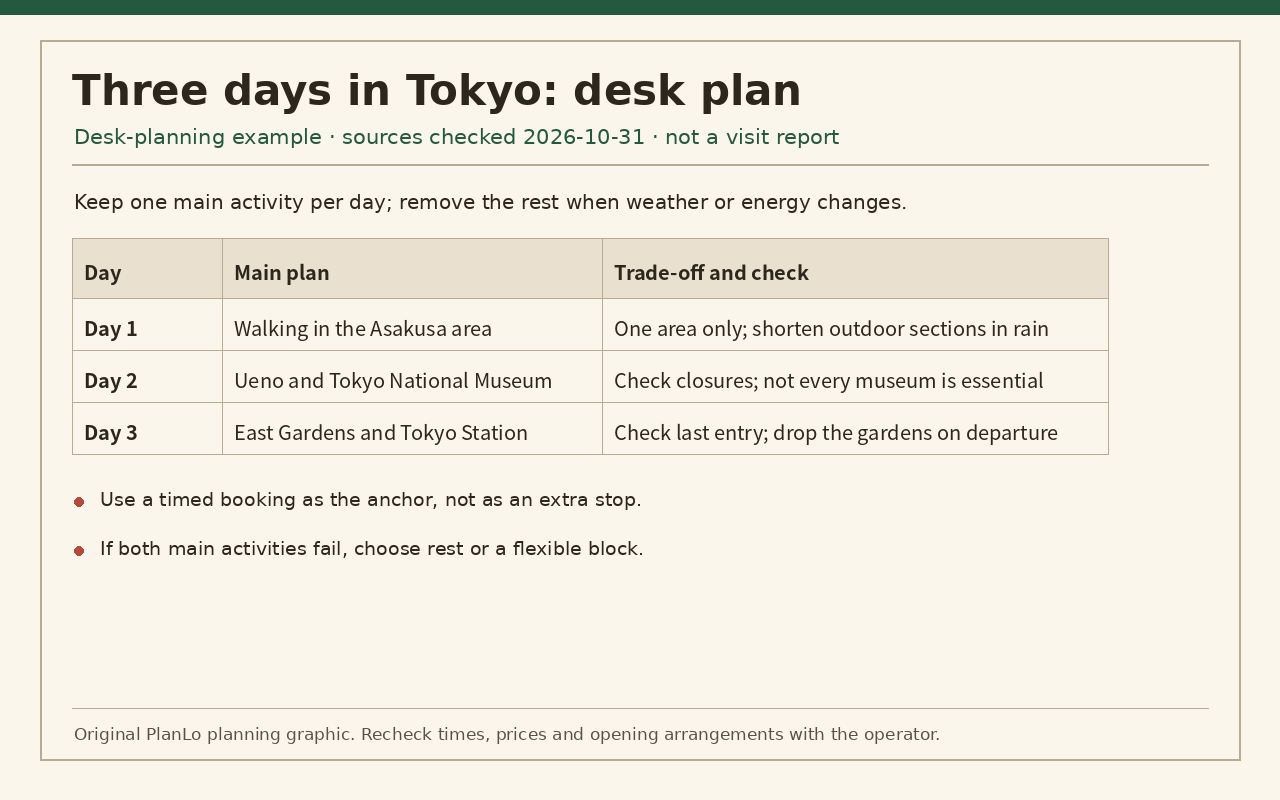
If the museum is closed on day two, swap the days and then check whether the East Gardens are affected by the same closure pattern. If neither main activity suits the date, do not fill the gap with more stops. Ask the group whether they prefer rest, shopping or an open-ended block instead. Keeping the must-do list short makes it possible to remove something when weather or energy changes.
When checking transport, treat the Tokyo Station area as several different entrances rather than one point. Add walking from the platform, finding the exit, waiting and eating to the route search result. The example does not claim one buffer that works for everyone; adjust it for the slowest member of the group and for luggage.
Rain and rest alternatives
Indoor activities can also close, sell out or require an outdoor walk from the station, so a museum is not automatically a rain substitute. Write the rain plan as “replace the outdoor activity after checking opening and entry conditions”, not as a second full itinerary. If the weather is severe or local authorities issue a warning, use local information and stay at the accommodation if that is the safer choice.
Mark meals and rest as flexible blocks and choose the exact place on the day rather than inventing queue times. If the walking load looks too high, make the day smaller. Dropping one area is usually easier for a group than stopping briefly at every station while everyone becomes tired.
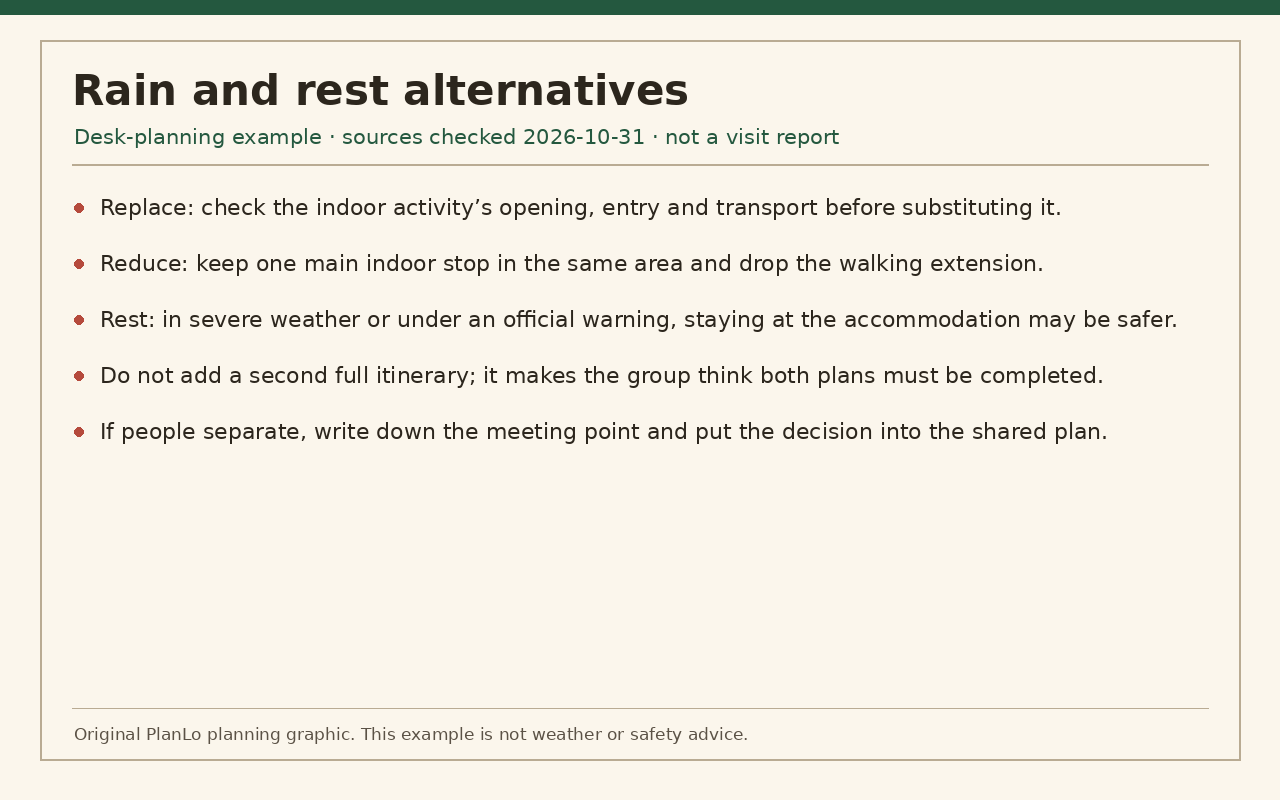
Finally, ask each companion to review the days, especially who needs an earlier rest, who will skip an activity, and where the group will meet if someone leaves. Put those decisions into the shared plan instead of leaving a version that appears to require everyone to stay together all day.
Put the route into the travel journal
Add the checked days to the PlanLo travel journal, with an official source, access date and cancellation condition for each main activity. Record the rain alternative clearly so the group knows which two items are alternatives rather than additions. Recheck transport and calendars before departure and keep the necessary offline information. The three-day table is a planning method, not a substitute for the operator’s notice on the day.
The example remains a desk plan. It shows the decisions to make and the links to verify; it does not claim that the route was walked, that tickets were bought or that every place was open.