Shared trip budget checklist: shared costs, personal spending and settlement
A trip budget is more than one estimated total. It should show which costs are shared, who paid first and when the group will check the figures. This example uses a fictional trip for A, B, C and D. Every amount is an assumption chosen so that the arithmetic can be recalculated; it is not a market price for a hotel, transport or meal, and no part of it describes a real journey.
All figures below use HKD and equal sharing unless stated otherwise. The example was prepared on 31 October 2026 and does not use a live exchange rate.
Separate shared and personal items
Start with two lists: shared costs and personal spending. Shared costs can include accommodation or transport that everyone agreed to divide. Personal spending can include shopping that only one person uses. The name of an item does not decide how it is split. If someone did not join a particular meal, check the original agreement instead of dividing every “food” line four ways.
Use labels A, B, C and D in a test table so that private information stays out of the shared file. When the plan becomes real, ask each person to check their own participation, sharing method and acceptable limit. If budgets differ, change the plan before arguing about the bookkeeping. Accurate arithmetic cannot fix an expense that nobody agreed to.
Agree in advance how refunds, deposits and part-payments will be recorded. One person may pay a deposit and another pay the balance for the same booking. Those payments should add up to one total cost, not create two full expenses.
Agree sharing and currency before departure
At minimum, the group should agree who joins each expense, whether it is shared equally or individually, and which currency is used for records and settlement. A budget is an estimate of future spending; it is not the same as a paid account. This example uses HKD throughout to keep the checks simple and does not assume an exchange rate or a zero foreign-transaction fee.
If the trip uses another currency, decide whether to record the amount actually charged, a named reference source or another method the group accepts. Record the date and how any fee is shared. Different payment tools may charge different fees, so one exchange rate cannot represent every transaction. Until the group agrees, keep the original currency and the original record rather than reducing everything to an untraceable converted total.
Example budget table and calculations
| Item | Assumed total | Per person | Assumed payer |
|---|---|---|---|
| Accommodation | 2400 | 600 | A |
| Shared transport | 800 | 200 | B |
| Shared meals | 1200 | 300 | C |
| Total | 4400 | 1100 | Not yet paid |
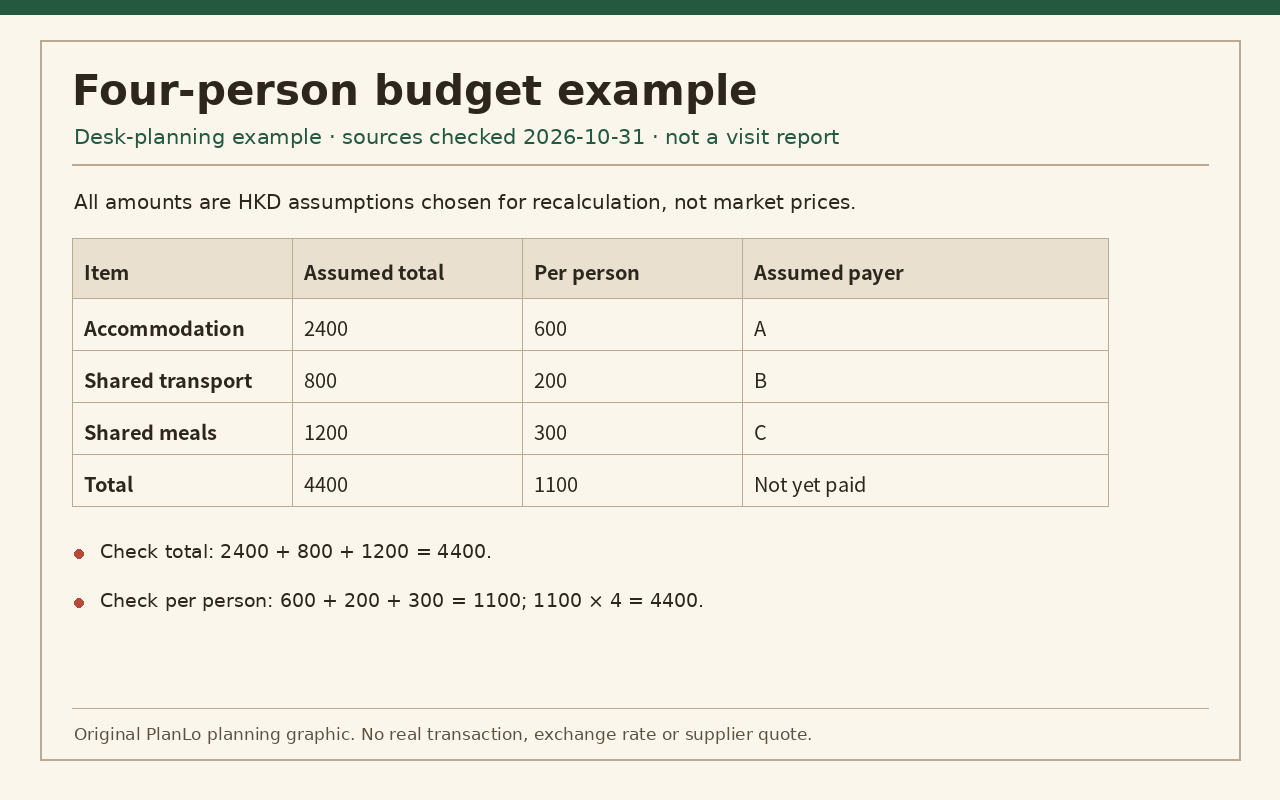
Check the total first: 2400 + 800 + 1200 = 4400. Then check the per-person amount: 600 + 200 + 300 = 1100, and 1100 × 4 = 4400. The payer column is only a pre-trip division of labour and should not be entered as money already paid.
If the actual payments match this assumption exactly, A has paid 2400 and owes 1100, so A should receive 1300. B has paid 800 and owes 1100, so B should pay 300. C has paid 1200 and owes 1100, so C should receive 100. D has paid nothing and owes 1100, so D should pay 1100. Amounts to receive total 1400 and amounts to pay total 1400. This is a conditional worked example, not a test result from the tool.
Personal shopping is outside the 4400 total and needs a separate personal allowance. Do not count money that has merely been reserved as money already spent.
Receipts and exchange-rate records
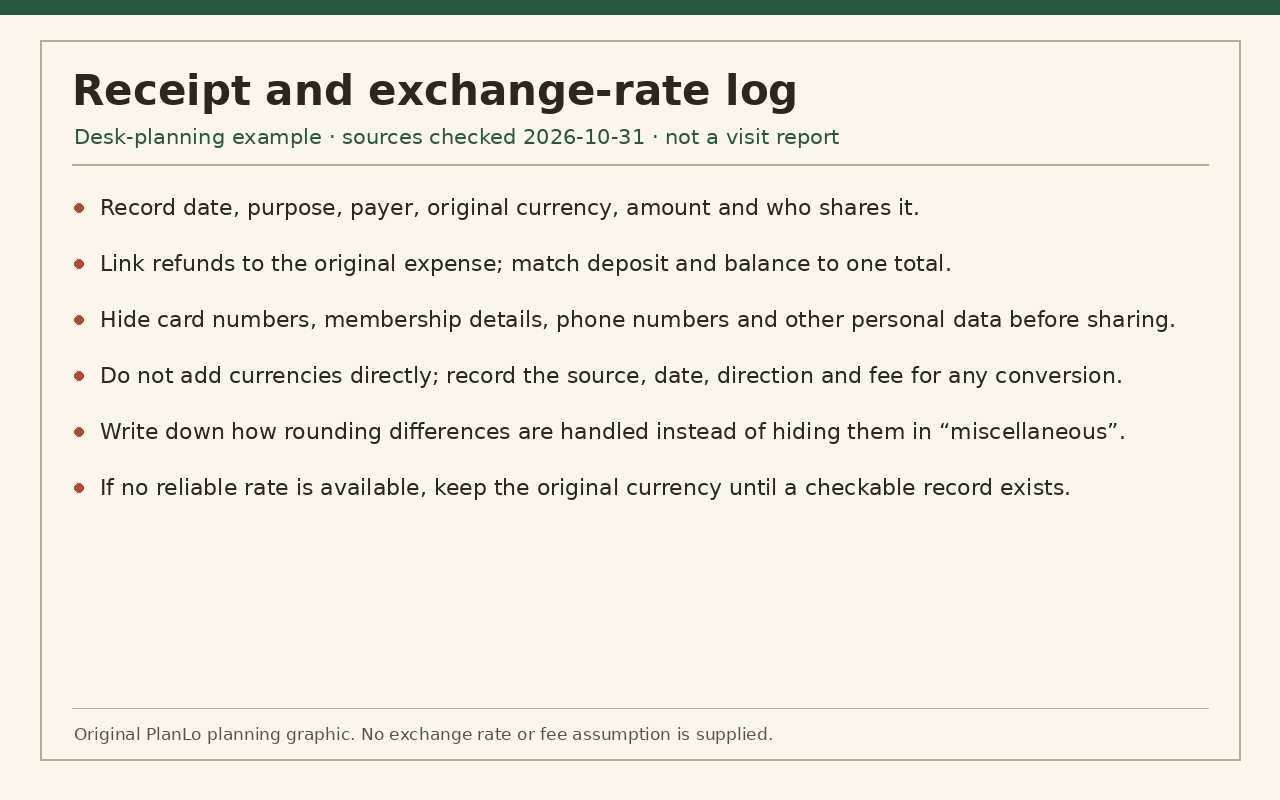
For each actual payment, record the date, purpose, payer, original currency, amount and who shares it. Refunds should link back to the original expense. Keep only the parts of a receipt needed for checking, and hide card numbers, membership details and other personal data before sharing. If one person pays a deposit and another pays the rest, match both payments to the same total instead of entering the full order twice.
Do not add different currencies directly. When converting, record the source, the transaction or access date, the direction of conversion and any fee. If rounding creates a small difference, write down how it will be handled so that the group can recalculate it. Do not hide the difference in an unexplained “miscellaneous” line. If reliable information is missing, keep the original currency and wait for a record that can be checked.
Check actual payments with the split tool
When real spending starts, open PlanLo Split and enter the actual payments. Confirm the participants first, then check the payer and the people sharing each expense. The figures in the tool should match the confirmed records. Do not ignore a refund or an extra charge just because the budget table said 2400. Keep the budget and the actual records as two different documents so that the difference remains visible.
After entry, check that total paid equals total shares and that each person’s net amount points in the right direction. A settlement suggestion is a payment instruction; it does not prove that the recipient has received the money. If someone pays part of the amount, record the date and remaining balance so the next check can continue instead of guessing what has been cleared.
This section is about checking the group’s travel budget. The separate tutorial on splitting a four-person meal covers the detailed operation of recording a single shared expense.
Return-trip settlement checklist
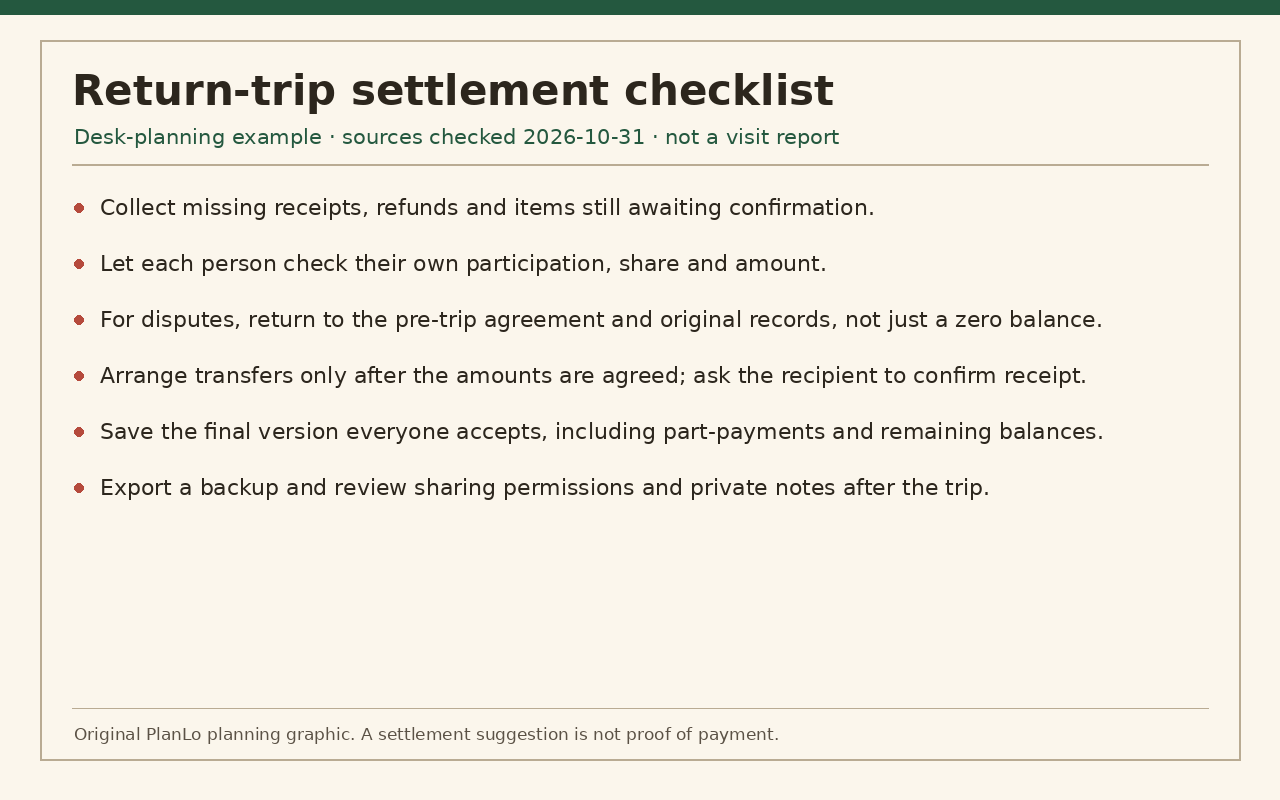
Before settling, collect missing receipts, refunds and disputed items, then let each person review their own share. If there is a disagreement, return to the pre-trip agreement and the original records instead of aiming only for a zero balance on screen. Arrange transfers after the amounts are agreed, ask the recipient to confirm receipt, and save the final version that everyone accepts.
Keep one final record that everyone has confirmed; receipts, payment identifiers and private notes that no longer need to be shared should be taken back or deleted. The same checklist can be reused next time, but the split method and currency must be agreed again rather than assumed.